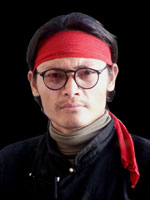
Tenzin Tsundue Tenzin Tsundue is a restless young Tibetan, who after graduating from Madras, South India, braved snowstorms and treacherous mountains, broke all rules and restrictions, crossed the Himalayas on foot and went into forbidden Tibet. The purpose? To see the situation of his country under Chinese occupation for himself, and find out if he could lend a hand or two in the freedom struggle. He was arrested by the Chinese border police, and after cooling his feet in prison in Lhasa for three months, was finally pushed back to India.
Born to a Tibetan refugee family who laboured on India's border roads around Manali, North India, during the chaotic era of Tibetan refugee resettlement in the early seventies. Tenzin Tsundue is a writer-activist, a rare blend in the Tibetan community in exile. He published his first book of poems Crossing the Border with money begged and borrowed from his classmates while doing his Master degree in Literature from Bombay University. His literary skills won him the first-ever 'Outlook-Picador Award for Non-Fiction' in 2001. His second book, Kora, has run into three editions and all are sold out. He is presently working on his third book, a compilation of essays on the Tibetan freedom movement.
Tenzin Tsundue joined Friends of Tibet (INDIA) in 1999. Since then he's been working with the organization as its General Secretary. In January 2002 his profile peaked when he scaled scaffolding to the 14th floor of the Oberoi Towers, in Mumbai, to unfurl a Tibetan national flag and a banner which read 'Free Tibet' down the hotel's facade. China's Premier Zhu Rongji was inside the hotel addressing a conference of Indian business tycoons. The world's media featured this feat and Indian police officials congratulated him in prison for standing up for his rights.
Last April, he repeated a similar feat with a stunning protest that captured the imagination of the world. Single-handedly, he snatched the world media attention from the visiting Chinese Prime Minister Wen Jia Bao in the south Indian city of Bangalore.
His writings have been published in International PEN, The Indian PEN, The Indian Literary Panorama, The Little Magazine, Outlook, The Times of India, The Indian Express, Hindustan Times, Better Photography, The Economic Times, Tehelka, Mid-Day (Mumbai), The Daily Star (Bangladesh), Today (Singapore), Tibetan Review, Freedom First, Tibetan World, and Gandhi Marg.
As a poet he represented Tibet in the Second South Asian Literary Conference in New Delhi in January 2005 organized by Sahitya Akademy, Poetry Africa 2005 and the recently concluded KATHA Asia International Utsav 2006. Both as an activist and a writer, Tsundue fights tooth and nail for the freedom of his country. His writings are published online at www.friendsoftibet.org/tenzin Tenzin Tsundue can be reached at tentsundue@yahoo.com.
News and Events
For an article about Tsundue's Summer 2008 march to Tibet, see A Long Walk Uphill. Also watch "Buddha's Warriors: The March", as reported by CNN.
raindrops wear boxing gloves,
thousands of them
come crashing down
and beat my room.
Under its tin roof
my room cries from inside
and wets my bed, my papers.
Sometimes the clever rain comes
from behind my room,
the treacherous walls lift
their heels and allow
a small flood into my room.
I sit on my island-nation bed
and watch my country in flood,
notes on freedom,
memoirs of my prison days,
letters from college friends,
crumbs of bread
and Maggi noodles
rise sprightly to the surface
like a sudden recovery
of a forgotten memory.
Three months of torture,
monsoon in the needle-leafed pines,
Himalaya rinsed clean
glistening in the evening sun.
Until the rain calms down
and stops beating my room,
I need to console my tin roof
who has been on duty
from the British Raj.
This room has sheltered
many homeless people,
now captured by mongooses
and mice, lizards and spiders,
and partly rented by me.
A rented room for home
is a humbling existence.
My Kashmiri landlady
at eighty cannot return home.
We often compete for beauty:
Kashmir or Tibet.
Every evening,
I return to my rented room;
but I am not going to die this way.
There has got to be
some way out of here.
I cannot cry like my room.
I have cried enough
in prisons and
in small moments of despair.
There has got to be
some way out of here.
I cannot cry;
my room is wet enough.
Our tiled roof dripped
and the four walls threatened to fall apart
but we were to go home soon.
We grew papayas
in front of our house,
chillies in our garden
and changmas for our fences,
then pumpkins rolled down the cowshed thatch
calves trotted out of the manger,
grass on the roof,
beans sprouted and
climbed the vines,
money plants crept in through the window,
our house seems to have grown roots.
The fences have grown into a jungle.
Now how can I tell my children
where we came from?
Changmas - a tree usually planted for fences; flexible and flourishing.
Though in a borrowed garden
you grow, grow well my sister.
This Losar
when you attend your Morning Mass,
say an extra prayer
that the next Losar
we can celebrate back in Lhasa.
When you attend your convent classes,
learn an extra lesson
that you can teach children back in Tibet.
Last year
on our Happy-Losar,
I had an Idli-Sambar breakfast
and wrote my BA final exams.
My Idlis wouldn't stand
on my toothed steely forks,
but I wrote my exams well.
Though in a borrowed garden
you grow, grow well my sister.
Send your roots
through the bricks,
stones, tiles and sand.
Spread your branches wide
and rise
above the hedges high.
Tashi Delek!
Tashi Delek - a greeting in Tibetan, said especially on the New Year.
Losar - Tibetan New Year, in February or March of the Christian calendar.
Lhasa - Capital of Tibet.
Idli-Sambar - A south Indian rice dish.
Somewhere along the path, I
lost it, don't know where or when.
It wasn't a one-fine-day incident.
As I grew up it just got left behind,
very slowly, and I didn't go back for it.
It was there when as a kid I used to wait
for the annual momo dinner,
when we lined up for gifts that came
wrapped in newspapers in our
refugee school, it was there when
we all gained a year together, before
birthdays were cakes and candles.
Somewhere along the path, I
lost it, don’t know where or when.
When new clothes started to feel
stiff and firecrackers frightening, when
our jailed heroes ate in pig sties there,
or were dead, heads smashed
against the wall as we danced
to Bollywood numbers here,
when the boarding school and uniforms
took care of our daily needs, when
family meant just good friends,
sometime when Losar started to mean
a new year, few sacred routines,
somehow, I lost my Losar.
Somewhere along the path, I
lost it, don’t know where or when.
Colleged in seaside city, when it was
still Bombay, sister’s family on pilgrimage,
uncle in Varanasi, mother grazing cows
in South India, still need to report
to Dharamsala police, couldn’t get train tickets,
too risky to try waiting list, and it’s
three days, including return journey
it’s one week. Even if I go,
other siblings may not find the time. Adjusting
timings, it’s been 20 years without a Losar.
Somewhere along the path, I
lost it, don’t know where or when.
Losar is when we the juveniles and bastards
call home, across the Himalayas and cry
into the wire. Losar is some plastic flowers
and a momo party. And then in 2008
when our people rode horses, shouting ‘Freedom’
against rattling machine guns, when they
died like flies in the Olympics’ spectacle,
we shaved our heads bald and threatened
to die by fasting, but failed. I
couldn’t die, it’s forbidden by law.
Somewhere along the path, I
lost it, don’t know where or when.
Somewhere, I lost my Losar.
Losar - Tibetan New Year, in February or March of the Christian calendar.